Cute Outline Heart Shape
First Impressions: Clean, Confident, and Quietly Thoughtful
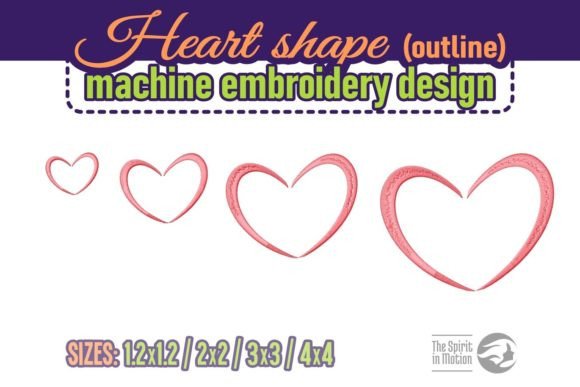
Opening the Cute Outline Heart Shape embroidery file, I didn’t see a cliché — I saw intention. This isn’t a thick, busy heart packed with swirls or glittery fills. It’s a single, smooth, continuous outline — slightly stylized, yes, but grounded in balance and proportion. The curves are generous but not exaggerated; the point is soft, not sharp. It reads as warm, modern, and quietly sincere — exactly the kind of machine embroidery design that feels handmade without shouting about it.
I immediately pictured it on a linen tea towel for a Mother’s Day gift — stitched in pale rose thread, no fill, just that clean line holding its shape against the natural weave. No fuss, no overdesign. Just presence.
A Real-World Test: Stitching It on a Cotton Canvas Tote Bag
Last week, I prepped a custom order: a set of three unbleached cotton canvas totes for a local boutique’s Mother’s Day launch. Their brief? “Timeless, tactile, gentle.” No florals. No script. Just one strong, quiet motif per bag. Cute Outline Heart Shape was the obvious choice — and it delivered.
Stitched at 3.2" wide with 40-weight rayon thread and medium tear-away stabilizer, the outline held crispness across the textured surface. No skipped stitches. No puckering. Because the stitch density is low (it’s purely an outline — no fill or satin stitch), it moved beautifully with the fabric instead of fighting it. Customers later told the boutique the hearts felt “light” and “thoughtful” — not decorative clutter, but a meaningful pause in the design.
Where It Shines — And Where to Pause
This embroidery file excels in projects where subtlety builds value:
- Custom apparel: Works flawlessly on sweatshirt cuffs, t-shirt hems, or baby onesie chest placements — especially when you want the garment to remain the star and the design to whisper, not shout.
- Embroidered patches: Clean edges mean easy cutting and clean backing. No dense fill to bulk up the patch or make it stiff.
- Nursery decor & baby embroidery: Its simplicity reads clearly even at small sizes (down to ~1.8"), and the lack of tiny interior details means no risk of loose threads or snagging on delicate skin.
- Holiday embroidery & personalized gifts: Paired with a monogram or short date, Cute Outline Heart Shape becomes a signature touch — not a theme, but a tone-setter.
That said, it’s not universally forgiving. On stretchy knits like jersey or thin fabrics like voile, I recommend testing with cutaway stabilizer and a light topping — the single-line nature means any distortion shows instantly. On dark fabric, contrast matters more than usual: a pale thread can vanish unless you add a subtle underlay or choose a matte metallic for lift. And on curved surfaces like caps? Keep it under 2.5" and center it carefully — the smooth curve doesn’t adapt well to extreme distortion.
What It Does for Your Craft Business
If you’re an Etsy seller or small shop owner, Cute Outline Heart Shape is quietly strategic. It’s versatile enough to anchor multiple product lines — think matching pillow covers + kitchen towels + baby blankets — while keeping your brand voice consistent. Because it’s minimal, it doesn’t compete with typography, photos, or packaging. It supports, rather than dominates.
Customers respond to that clarity. In mockups, it reads as intentional — not generic clip art. That perception lifts perceived value. A $28 embroidered tote feels like a curated piece when the heart is precise, balanced, and unstudied. It signals care in execution, which builds trust — especially for personalized gifts where emotional resonance matters more than flash.
For digital product sellers: this is a strong foundational asset. Pair it with a simple script font or minimalist border, and you’ve got a ready-made collection for printable mockups or layered embroidery project kits. Just confirm licensing allows commercial use before bundling — always check before listing.
Designer Notes You’ll Actually Use
Before stitching Cute Outline Heart Shape into your next finished product, here’s what I do — every time:
- Test on scrap fabric first, using the exact stabilizer and thread you’ll use in production. Texture changes everything.
- Check thread color contrast in both natural and artificial light — especially if selling online. A soft grey thread may look elegant on screen but disappear on oat-colored linen.
- Review stitch density: Since this is a running stitch outline, density isn’t high — but verify no overlapping passes or unnecessary jumps that could cause thread breaks on older machines.
- Confirm hoop size compatibility. Even simple designs can push limits on compact hoops — measure the widest point and add ¼" buffer.
- Inspect corners and curves at 200% zoom in your embroidery software. Does the path flow smoothly? Are there micro-gaps or abrupt angle shifts?
- Test it in black-and-white mockups. If it holds visual weight without color, it’s strong design.
- Compare light and dark backgrounds side-by-side. What reads as “delicate” on white may read as “faint” on charcoal.
- Use proper stabilizer — medium tear-away for stable wovens, cutaway for knits or lightweight fabrics.
- Verify licensing before selling finished items or digital bundles. This is non-negotiable for craft business integrity.
Final Thought: Less Is Anchored Here
Cute Outline Heart Shape doesn’t try to be everything. It’s not a statement piece, nor is it background noise. It’s a hinge — a quiet, confident moment where design meets feeling. Whether you’re stitching a Mother’s Day apron for a client, building a cohesive line of boutique merchandise, or adding polish to your Etsy shop’s bestsellers, this embroidery file earns its place by doing one thing exceptionally well: holding space with grace.
That’s rare. And useful. And — honestly — why I keep it in my go-to folder.